 BUFFR: Retrospective Audio and MIDI Recorder Plugin
Never miss happy accidents again.
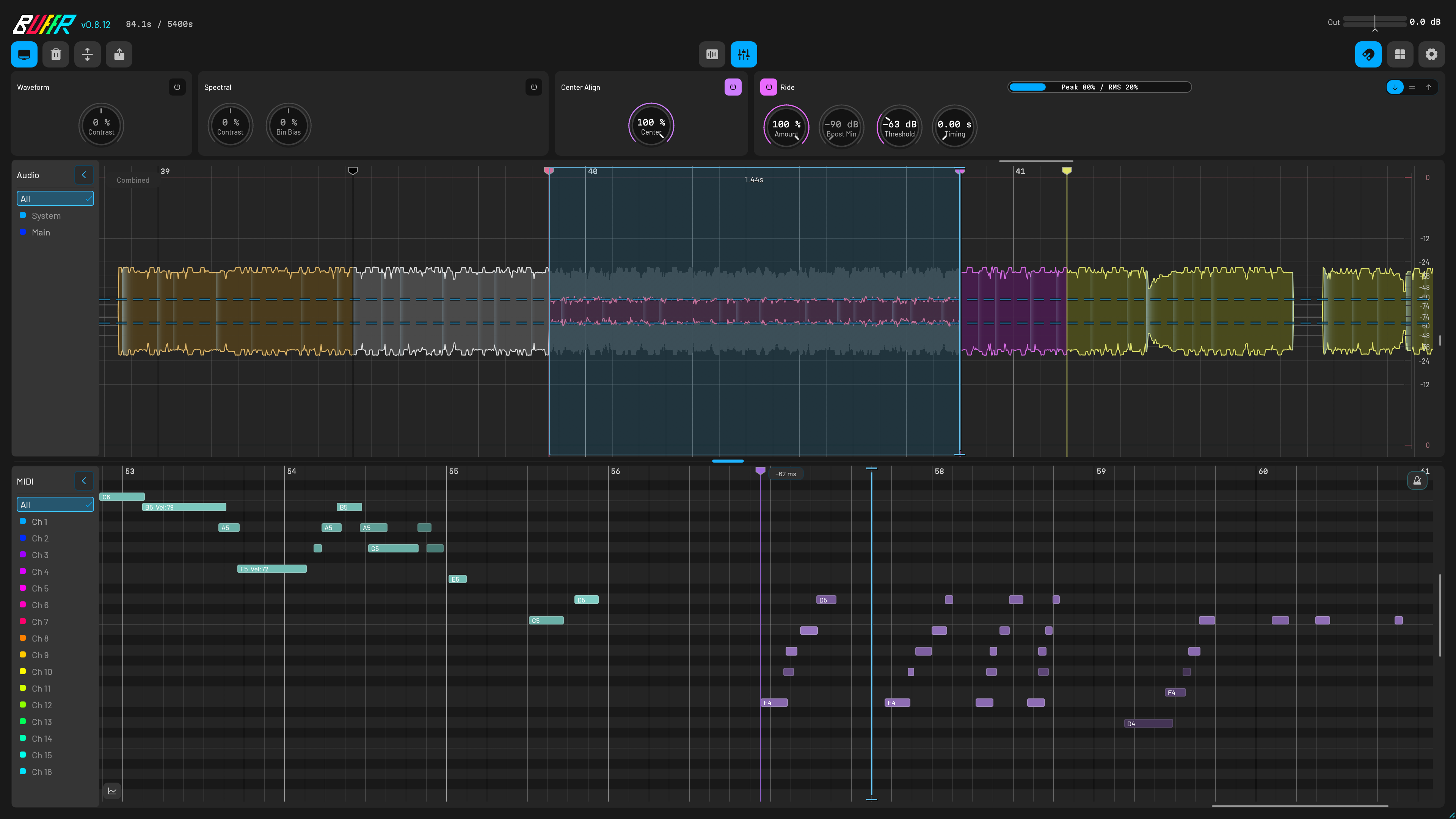
A retrospective audio and MIDI recorder plugin that keeps up to two hours of DAW audio, System Audio, and MIDI ready to edit and drag back—even when Record was never armed.
Launch priceEnds Sep 8 at 17:00 UTC



See BUFFR in action
BUFFR has infinite possibilities, so you never miss anything cool you made.
Retrospective audio and MIDI recording features
Always listening
- Keeps up to two hours of audio and MIDI after you play.
- Silent channels skip RAM. Recovery writes to disk if the host dies.
- Always, on sound, or manual.
Smart Quantize
- Blend Raw, Human, and Precision on the whole take, a marker, or a selection.
- Reads chords, rolls, swing, and tuplets, then tightens them without flattening the feel.
- Shows the grid it used, and how early or late each phrase sat.
Center Align and Ride
- Center Align evens the positive and negative peaks.
- Ride holds a target from instant to five seconds and draws the gain on the waveform.
- Wet, Normalize, drag, and export share one cached result.
Spectrogram
- Full frequency history, from a whole-take overview down to single bins.
- Alt-drag a sound, preview it, drag it out.
- FFT, minimum-phase, or linear-phase at the selection length.
System Audio
- Desktop audio as its own stereo lane. No loopback plugin. macOS asks once.
- Main plus seven stereo Aux lanes in one instance.
- Capture Sources lists every input and whether it is moving.
MIDI
- All 16 channels from the DAW, a global controller, or both.
- Global mode still hears the keyboard when BUFFR sits on the master.
- Notes, CC, bend, MPE. SMF export down-converts what a MIDI file cannot keep.
Drag out
- Drag audio, MIDI, or a Spectral Grab into the DAW.
- Audio is 24-bit FLAC by default. WAV is in Settings. MIDI is a Standard MIDI File.
- If a drop fails, use Export.
Snap and markers
- Chords, velocity, swing, and transients show up before you edit.
- One Snap control: grid, transients, zero crossings, markers, MIDI. Shift bypasses it.
- B or CC 20 drops a marker. Name and move them per lane.
Controls
- Right-click Export, Waveform, Spectral, or Grid for the settings that belong there.
- Keyboard, focus, and screen-reader behavior stay consistent.
- Themes, MIDI colors, CLAP and VST3 on every desktop OS, always-on-top window.
More than a rolling recorder.
Compare what each tool remembers, what it can shape, and how the take returns to your DAW.
| Capability | BUFFRDAW audio + MIDI + System Audio | RewindAudio + MIDI; System mode in standalone | Rolling SamplerRetrospective audio | MIDI CapRetrospective MIDI |
|---|---|---|---|---|
| Maximum published historyHow far the current first-party material says the recorder can look back. | 120 minutesSelectable 1–120; dense audio remains RAM-resident, with separate recovery checkpoints | Up to 90 minutesProduct, Welcome, and settings agree; other manual sentences conflict at 30/60 | Stable: 10 minutesDefault 45 seconds; 1.4 beta says increased but gives no number | 60 minutesDefault 60 seconds; adjustable to one hour |
| DAW audio capacityWhat one loaded recorder can retain from the host. | Up to 16 DAW slotsStereo Main plus seven host-routed stereo Aux pairs | Insertion-point mixStandalone inputs are merged into one export track; the plug-in records its routed channel/master | One audio streamAudio reaching the plug-in | NoneCLAP audio passes through but is not retrospectively recorded |
| Retrospective MIDIRecover played notes and controller data after the performance. | 16 channels + MPE/UMPDAW or direct device; rich events retained in the buffer | MIDI + CC/MPEVendor warns Ableton drag-in can lose MPE and Bitwig can truncate CC | NoneAudio-only recorder | MIDI + CCMultichannel; vendor says MPE support is unfinished |
| Controller without arming BUFFR’s trackOpen a hardware MIDI device from a bus or master rather than routing it to the recorder track. | Built inSystem device opens the OS input; matching DAW/device duplicates collapse automatically | Direct device or DAW inputThe manual makes them mutually exclusive; Windows sharing can require its SharedMIDI extension and a cloned DAW port | NoneNo MIDI capture | No direct-device modeVendor’s typical setup is a record-armed, always-monitored MIDI track |
| System Audio inside the retrospective plug-inRetain computer output beside DAW material without leaving the plug-in workflow. | Built in · separate stereo laneNo third-party cable or bridge; macOS 13+ grants permission to the bundled helper | Standalone onlyExternal/System switch clears current memory; macOS reroutes output, Windows selects an app | Not in stable plug-inStable uses loopback/System Audio Bridge; 1.4 beta adds experimental Windows standalone capture | NoneMIDI only |
| Spectral extractionSelect a sound by both time and frequency before exporting it. | Only BUFFR: Spectral GrabAlt-drag, audition, then export with FFT, minimum-phase, or linear-phase reconstruction | No spectral workflowTime/waveform selection | No spectral workflowTime/waveform selection | Not applicable |
| History after a host crashWhat the documented workflow does with unsaved recorder history. | Five-second checkpointsSaved instance identity restores audio, MIDI, and markers; an abrupt tail may be lost | RAM cache with loss warningsClosing standalone or changing source/length can clear memory; no checkpoint-restore workflow in its manual | RAM loop onlyFiles are created on drag; no restore workflow in stable manual | No restore workflowManual describes the live plug-in buffer and drag-out |
| Linux Wayland-session drag-outHow retrospective file drag is handled in Linux desktop sessions. | Open Wayland/XWayland-aware backendMatari-tested on Hyprland, niri, KDE Plasma, GNOME, and Xfce; Void and NixOS also tested | No Linux build | Vendor warns drag can failSome Linux distribution/DAW combinations | No Linux build |
Matari makes BUFFR. Other cells come from vendor docs, last checked July 25, 2026. Missing docs are not treated as a feature.
Loading builds…
What users noticed
Press & producers
Attributed reactions, with original wording where translated.
Press impression“I think Matari Audio is onto something here, and my first impressions are great.”
Translated press impression“A useful plugin for creators who want to preserve unexpected ideas and great performances.”
“思いがけないアイデアや名演を残したいクリエイターにとって便利なプラグインです。”
Translated user reaction“I tried it and was impressed. BUFFR captures the output wherever it is inserted, and MIDI is easy to understand on the same timeline.”
“試して感動。BUFFR ではどこに挿しても出音をキャプチャーできる。MIDI も同一のタイムラインで表示されて分かり易い。”
Public reviews
Unfiltered ratings from people who used BUFFR.
—Loading public reviews…
Independent reviews collected through Yotpo.
FAQ
Before you install.
How does the trial work?
Install BUFFR and start the one-time 28-day trial on that computer. Buy a perpetual license when you are ready, then activate up to three computers and receive updates through version 1.x.
What can it capture?
Up to 16 DAW audio channels, all 16 MIDI channels, and a separate System Audio lane. Only while BUFFR is loaded. It cannot recover audio from before you inserted it.
Does audio leave my machine?
No. Capture, edit, and export stay local. Matari only gets data you send on purpose, like a support report.
What can I run it on?
CLAP and VST3 on macOS, Windows, and Linux. The signed Mac installer also includes AUv2 for Logic, and every platform includes a standalone app.
How do I get a take out?
Select it and drag. If the DAW will not take the drop, use Export.
How is BUFFR different from an audio recorder VST?
A conventional recorder starts writing a known input to a file. BUFFR keeps a rolling audio and MIDI history, so you can choose the useful range after you play it.
Is this Buffr Glitch, a buffer pedal, or the jewelry brand?
No. BUFFR is Matari Audio’s retrospective audio and MIDI recorder plugin for DAWs. It is not Robbert van der Helm’s Buffr Glitch, a guitar buffer, or the Buffr ring protector.
Roadmap
What ships now, then what comes next. 28 shipped · 1 next · 6 planned